Spring

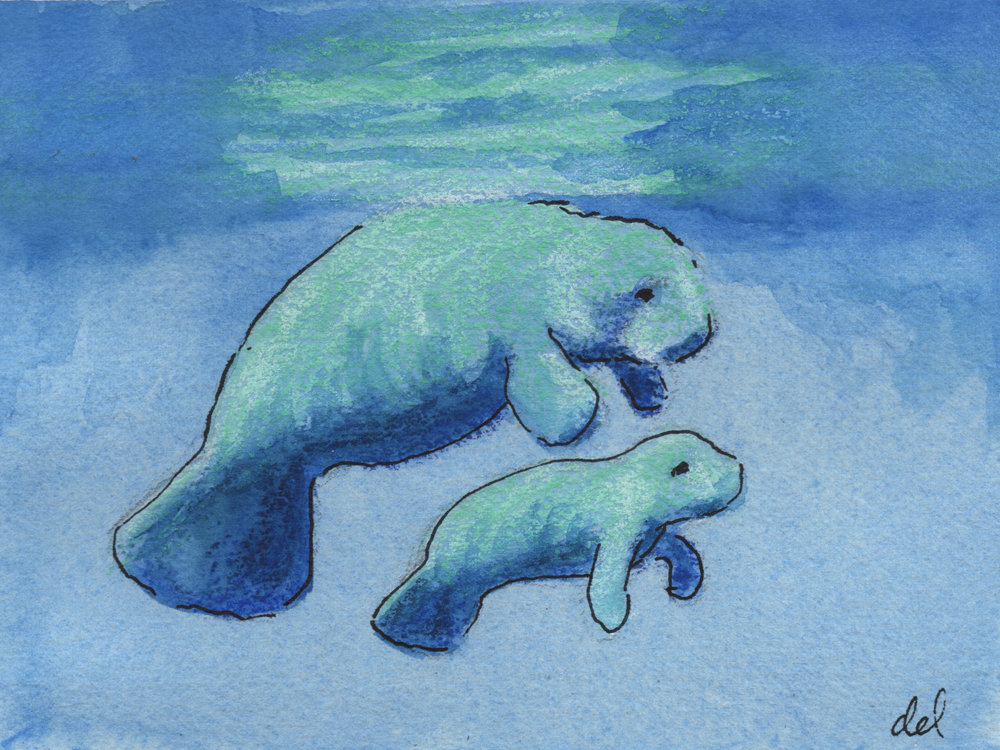
Spring Calf
Spring Calf

Inspired by a fellow blogger’s challenge to come up with something blue that says “spring”. http://decorartuk.wordpress.com/2014/03/22/something-in-common/  The local manatees came to mind right away. They are also known as sea cows and have a fairly bovine personality – sweet, slow and docile, not to mention big.

One time while walking near a dock I saw some manatees and one seemed to have a problem. After talking to a local officer they found that she had been playing this trick all along the coast and in fact she was fine, but seemed to like the attention. Silly cow.

Here’s a nice video, so you can see what they look like:

https://www.youtube.com/watch?v=p7txP9MOCqs

Some basic manatee facts:

http://www.savethemanatee.org/manfcts.htm

and then there’s this – were they the basis for the myth of mermaids? I think so!

http://www.savethemanatee.org/sirenian.htm

Changing Course in 2014

As usual in the beginning of the year I think of all the millions of things that I want to do and this year I’m going to start with focusing on one thing.  It’s a huge thing, sort of overwhelming at times, but, I think I need to do it …… and it will consume the whole year.

For the past two years I’ve been participating in PiBoIdMo (Picture Book Idea Month) held in November – which is a challenge that Tara Lazar has organized. So, now I have two files of ideas, about 65 in all (not all good ideas) and it seems there ought to be something worth pursuing. http://taralazar.com

This year I’ve joined Julie Hedlund’s group – 12 x 12 in 2014, which is a writing challenge to write 12 children’s book drafts during the year, one a month, from the ideas generated in the aforementioned idea challenge. http://www.juliehedlund.com/

So I’m challenged and motivated to get some work done this year.

12-x-12-new-badge

Palette Talk

Originally my plan was to write about Sorolla and his palettes, however while researching I found the definitive article written on Sorolla, his palettes and technique. The article was written in 1990 by Charles Sovek as a cover article for The Artists Magazine.

The article is here:  http://www.sovek.com/publications/articles/sorolla/index.htm

Sorolla’s palettes were different for portraiture or outdoor landscape, as stated in the article:

“Varying with the subjects he painted, Sorolla used essentially two different color palettes. For studio portraits, he favored one that included black, burnt umber, raw umber, rose madder, burnt sienna, raw sienna, yellow ochre, Naples yellow, vermilion and cobalt blue. Occasionally he would add orange, pink or purple, but he usually emphasized strong tonal contrasts over ambitious color effects. His outdoor palette was completely different and included cobalt violet, rose madder, all the cadmium reds, cadmium orange, all the cadmium yellows, yellow ochre, chrome green (since replaced by permanent green light), viridian, Prussian blue, cobalt blue and French ultramarine. In both cases, he used lead white.”

Unfortunately Charles Sovek passed away in 2007, however his website remains and is loaded with valuable information and is maintained by The Charles Sovek Estate.

http://www.sovek.com/index.htm

On the top of his section “Speaking of Art” he talks about the palette based on the color wheel, or a rainbow palette, which is similar to what I use, sometimes less and sometimes more, depending on what I’m painting, but a good color wheel palette in any medium keeps your paintings bright and less muddled.

Sovek’s suggestion is: Dioxine purple, permanent rose, cadmium red light, cadmium orange, cadmium yellow medium, cadmium yellow light, thalo green, cerulean blue, ultramarine blue, white, black.

Personally, most of the time I don’t use the purple, thalo green, cerulean blue or black and try to mix those instead. Sometimes I’ll use thalo blue (carefully – it’s a strong color). Also I use Veridian. But basically it does stay fresh and is a rainbow palette.

In the past I’ve discussed palettes for pastels and do in fact use different palettes for portraits and landscapes, more earthtones for the portraits and more of a color wheel selection for landscapes.

Because of copyright issues I haven’t included one of Sovek’s paintings here but strongly urge you to visit the website and look through his galleries as well as the “Lessons from the Easel”. He was a wonderful painter and teacher. You can get his books and dvd’s there also.

This website is also interesting, Sorolla’s paintings and biography:

http://www.joaquin-sorolla-y-bastida.org/


Molly’s House Gallery

For locals – here is the season’s schedule for Molly’s House Gallery in Stuart, FL:

2013 2014 Gallery Flyer

My mostly beach themed paintings will be there in December, from the 5th until the end of the month.

Molly’s House is a 501(c)3 hospital hospitality house, providing temporary lodging for adult and children patients and their families who are receiving medical care on the Treasure Coast.

www.MollysHouse.org


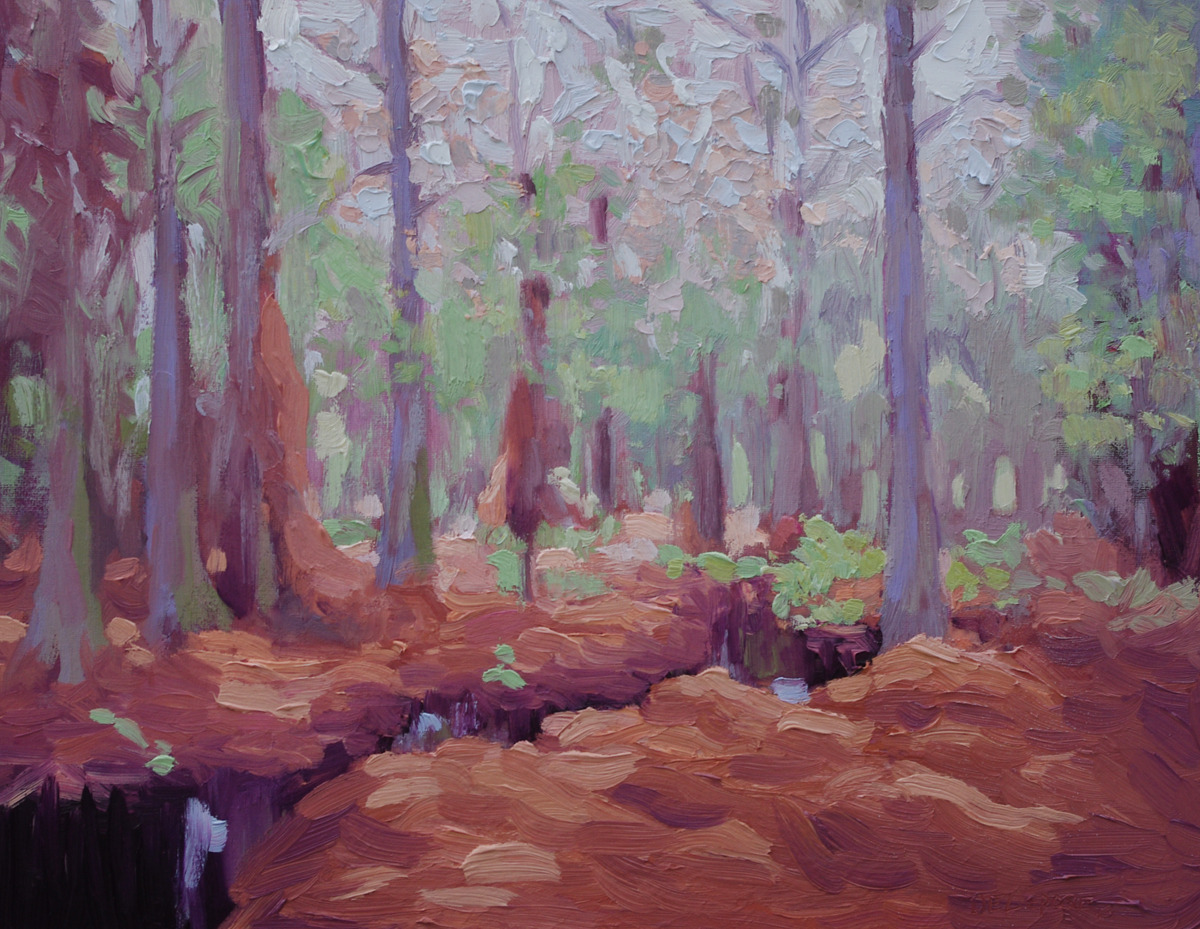
Barley Barber Swamp

Barley Barber Swamp
Barley Barber Swamp – oil on board – 11×14

The only way to get to Barley Barber Swamp is to be taken there by bus. It’s located in the middle of FPL property in Indiantown, FL.  This link tells you more about how to get there if you’re local:  http://www.treasuredlands.org/blog/news and this one tells you more about the swamp:  http://www.barleybarber.org/

Once you get to the Seminole Inn and hop on the tour bus you get a bumpy ride past the FPL plant and arrive at the swamp in the middle of nowhere but is actually close to Lake Okeechobee that you can’t see from there. The tour follows a windy boardwalk through the ancient cypress swamp that is host to otter eating gators, many tree frogs and assorted rarely seen vegetation.

Toward the end of the boardwalk tour I captured several shots of the most beautiful area of the swamp where all the cypress needles had turned the land into a carpet of red. It would have been even more stunning if the sun were out that day.

The Reed Pen

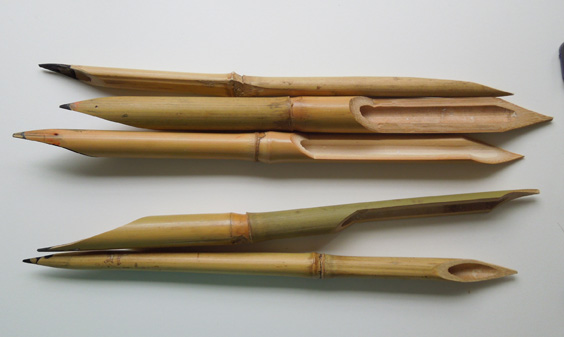
The reed pen is a very simple instrument that van Gogh used to perfection during his time in Arles. Vincent made his own pens and after buying some I see why. The pens that you can buy at art supply stores are made of bamboo and the ones that I bought were marked small, medium and large – all the same price.  It took me a little while to figure out what the sizing meant. The sticks were similar in size and it was actually the points that were different sizes. After using the pens, I’ve decided to modify them to suit my needs because I find that the finer points aren’t very useful.

reed pens
reed pens

Drawing with a reed pen is fun and requires a mark making language. Mine needs more development. The paper I used was a heavy weight, 140 lb., hot pressed watercolor paper. van Gogh used laid paper and I did find some at Staples but haven’t tried it yet, other than to scribble and see how it feels. The reed pen flows better on the stationery than the watercolor paper. I’ll keep trying other papers until I find one that works best for me.

Here is my attempt at a reed pen ink drawing:

reed pen and ink drawing

van Gogh’s Drawings

The drawings that are part of Vincent’s letters to Theo are interesting and all his talk of etchings and drawings by other artists, as well as his own, led me to the catalogue by the Metropolitan Museum “Vincent van Gogh – The Drawings”.  (The catalogue is from a 2005 exhibit.) It’s too bad I missed this exhibit but maybe some day I’ll see his drawings in person. Years ago I saw a number of his paintings in Boston and was completely awestruck. I think the drawings would have the same effect.

Here is a synopsis of the exhibit/catalogue by Eric Gelber on Art Critical:

http://www.artcritical.com/2003/11/01/vincent-van-gogh-the-drawings/

However, I’d like to change his last line to “take up our reed pens”. The reed pen was the instrument used for the most vibrant of van Gogh’s drawings.

Many of Vincent’s drawings can be seen online here:

http://www.vangoghgallery.com/catalog/Drawing/

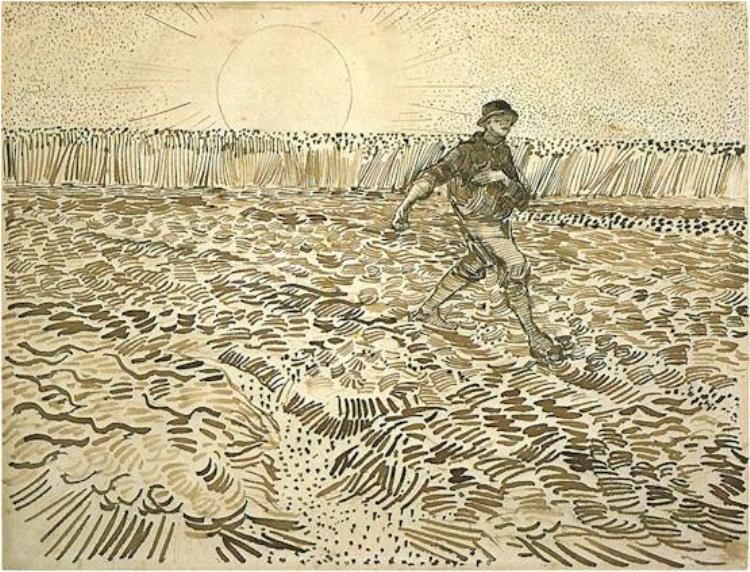
It is said that his best drawings, the drawings considered his most important, were the ones that were done  during July and August 1888 in Arles. (also, notice – done with the reed pen.)

van Gogh drawing - Sower-with-Setting-Sun
van Gogh drawing – Sower-with-Setting-Sun
Reed Pen, quill and ink over graphite  on wove paper – 9 5/8″ x 12 5/8″

from Vincent’s letter to Theo:

“Now the Harvest, the Garden, the Sower, and the two marines are sketches after painted studies. I think all these ideas are good, but the painted studies lack clearness of touch. That is another reason why I felt it necessary to draw them.”

Usually artists draw as a preliminary step to a painting – working out the kinks. But, many times Vincent would draw after a painting to study it further or to show his brother Theo what he was working on.

Next: Trying out the Reed Pen


van Gogh – the original blogger

You know how people always talk about going full circle? Well, this is one of those instances. How it happened is a mystery but I recently rediscovered Van Gogh’s letters online. Yes, I’d seen them online before, noted it, and moved on. This time, however, I’ve become obsessed with them – again. The first obsession was a very long time ago, hate to even admit how long ago, (so I won’t) when I read them straight through like a novel. It occurred to me this time that Vincent was the first blogger – writing about his thoughts, inspiration and moods while adding drawings to illustrate his point in his letters to Theo. Now that I’m much older and maybe a little wiser, I’m understanding more and relating better to what he had to say.

Here is the link to the van Gogh letters:

http://www.webexhibits.org/vangogh/

Although it’s fun to click on various topics, you can go to the Calendar of all letters and just start from the beginning.

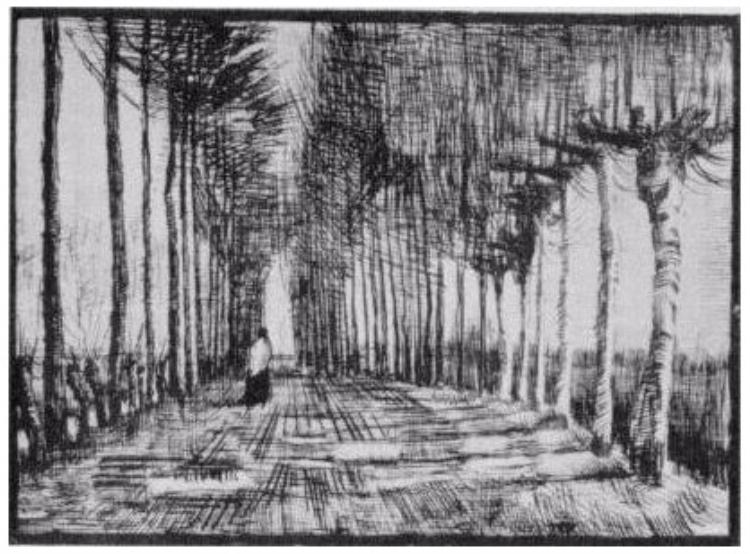
van Gogh drawing
van Gogh drawing – Lane with Trees and One Figure

“Mauve takes it amiss that I said, `I am an artist,’ which I  won’t take back, because it’s self-evident that what that word implies is looking for something all the time without ever   finding it in full. It is the very opposite of saying, `I know all about it, I’ve already found it.’ As far as I am concerned, the word means, `I am looking, I am hunting for it, I am deeply    involved.'” Vincent van Gogh from a letter to his brother Theo

http://www.webexhibits.org/vangogh/letter/11/192.htm

to be continued…