The Reed Pen

The reed pen is a very simple instrument that van Gogh used to perfection during his time in Arles. Vincent made his own pens and after buying some I see why. The pens that you can buy at art supply stores are made of bamboo and the ones that I bought were marked small, medium and large – all the same price.  It took me a little while to figure out what the sizing meant. The sticks were similar in size and it was actually the points that were different sizes. After using the pens, I’ve decided to modify them to suit my needs because I find that the finer points aren’t very useful.
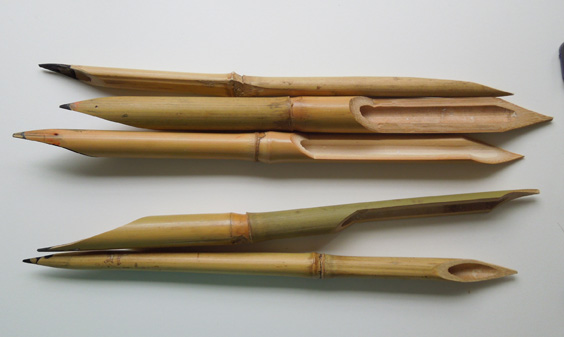
reed pens
reed pens

Drawing with a reed pen is fun and requires a mark making language. Mine needs more development. The paper I used was a heavy weight, 140 lb., hot pressed watercolor paper. van Gogh used laid paper and I did find some at Staples but haven’t tried it yet, other than to scribble and see how it feels. The reed pen flows better on the stationery than the watercolor paper. I’ll keep trying other papers until I find one that works best for me.

Here is my attempt at a reed pen ink drawing:

reed pen and ink drawing

van Gogh’s Drawings

The drawings that are part of Vincent’s letters to Theo are interesting and all his talk of etchings and drawings by other artists, as well as his own, led me to the catalogue by the Metropolitan Museum “Vincent van Gogh – The Drawings”.  (The catalogue is from a 2005 exhibit.) It’s too bad I missed this exhibit but maybe some day I’ll see his drawings in person. Years ago I saw a number of his paintings in Boston and was completely awestruck. I think the drawings would have the same effect.

Here is a synopsis of the exhibit/catalogue by Eric Gelber on Art Critical:

http://www.artcritical.com/2003/11/01/vincent-van-gogh-the-drawings/

However, I’d like to change his last line to “take up our reed pens”. The reed pen was the instrument used for the most vibrant of van Gogh’s drawings.

Many of Vincent’s drawings can be seen online here:

http://www.vangoghgallery.com/catalog/Drawing/

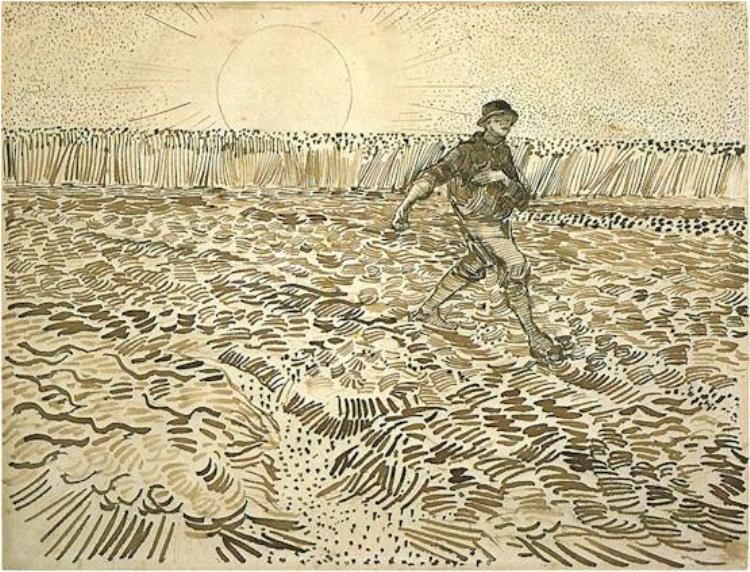
It is said that his best drawings, the drawings considered his most important, were the ones that were done  during July and August 1888 in Arles. (also, notice – done with the reed pen.)

van Gogh drawing - Sower-with-Setting-Sun
van Gogh drawing – Sower-with-Setting-Sun
Reed Pen, quill and ink over graphite  on wove paper – 9 5/8″ x 12 5/8″

from Vincent’s letter to Theo:

“Now the Harvest, the Garden, the Sower, and the two marines are sketches after painted studies. I think all these ideas are good, but the painted studies lack clearness of touch. That is another reason why I felt it necessary to draw them.”

Usually artists draw as a preliminary step to a painting – working out the kinks. But, many times Vincent would draw after a painting to study it further or to show his brother Theo what he was working on.

Next: Trying out the Reed Pen


van Gogh – the original blogger

You know how people always talk about going full circle? Well, this is one of those instances. How it happened is a mystery but I recently rediscovered Van Gogh’s letters online. Yes, I’d seen them online before, noted it, and moved on. This time, however, I’ve become obsessed with them – again. The first obsession was a very long time ago, hate to even admit how long ago, (so I won’t) when I read them straight through like a novel. It occurred to me this time that Vincent was the first blogger – writing about his thoughts, inspiration and moods while adding drawings to illustrate his point in his letters to Theo. Now that I’m much older and maybe a little wiser, I’m understanding more and relating better to what he had to say.

Here is the link to the van Gogh letters:

http://www.webexhibits.org/vangogh/

Although it’s fun to click on various topics, you can go to the Calendar of all letters and just start from the beginning.

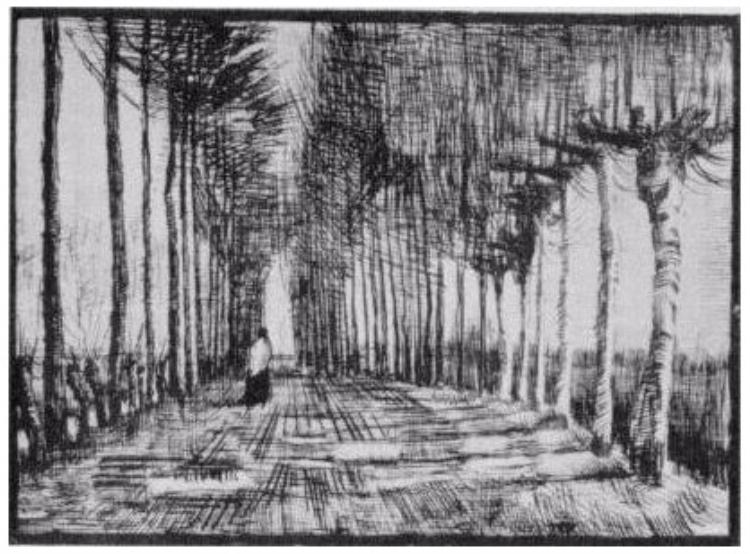
van Gogh drawing
van Gogh drawing – Lane with Trees and One Figure

“Mauve takes it amiss that I said, `I am an artist,’ which I  won’t take back, because it’s self-evident that what that word implies is looking for something all the time without ever   finding it in full. It is the very opposite of saying, `I know all about it, I’ve already found it.’ As far as I am concerned, the word means, `I am looking, I am hunting for it, I am deeply    involved.'” Vincent van Gogh from a letter to his brother Theo

http://www.webexhibits.org/vangogh/letter/11/192.htm

to be continued…

Live Oak Concerto

Live Oak Concerto
Live Oak Concerto – Oil on Panel – 12×16

Haven’t had a chance to post anything lately.

These live oaks are located at Adams Ranch in Ft. Pierce.  They have such a happy,  lyrical,  uplifting look to them that I had to paint them with happy squiggles.

The painting panels I use are “Pintura” and they are canvas on wood.

Tin Roof – Rusted

Tin Roof - Rusted
Tin Roof – Rusted – oil on panel – knife painting – 11×14

This painting was done in Ft. Pierce as part of an invitational paint out.  The last time I was in the neighborhood, this building was completely renovated.  It wouldn’t be my choice as a painting subject anymore because all the character was removed.

The title is from that song by the B52’s – “Love Shack”.  Of course being in Ft. Pierce it was probably more likely a Drug Shack.

John Pierce Barnes

There was an interesting article in the June issue of “Pastel Journal”  titled “History Reclaimed” about John Pierce Barnes (1893-1954), an impressionist artist, who was discovered recently.  The pastel paintings that they show on the Pastel Journal website are stunning.  In order to avoid any problems I haven’t included any pictures of his paintings here.

This link is to the Pastel Journal Blog:

http://www.artistsnetwork.com/medium/pastel/john-pierce-barnes-gallery

You can read the story in the following link,  about how the curator of his paintings, Katherine Stanko, learned that the paintings existed and had been in storage since the artists death or maybe longer.

“THE RESURRECTION OF ARTIST JOHN PIERCE BARNES, RCA Worker and Impressionist Painter” By Hoag Levins is here:

http://historiccamdencounty.com/ccnews145.shtml

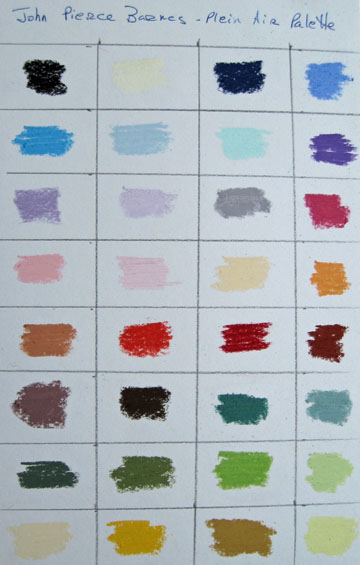
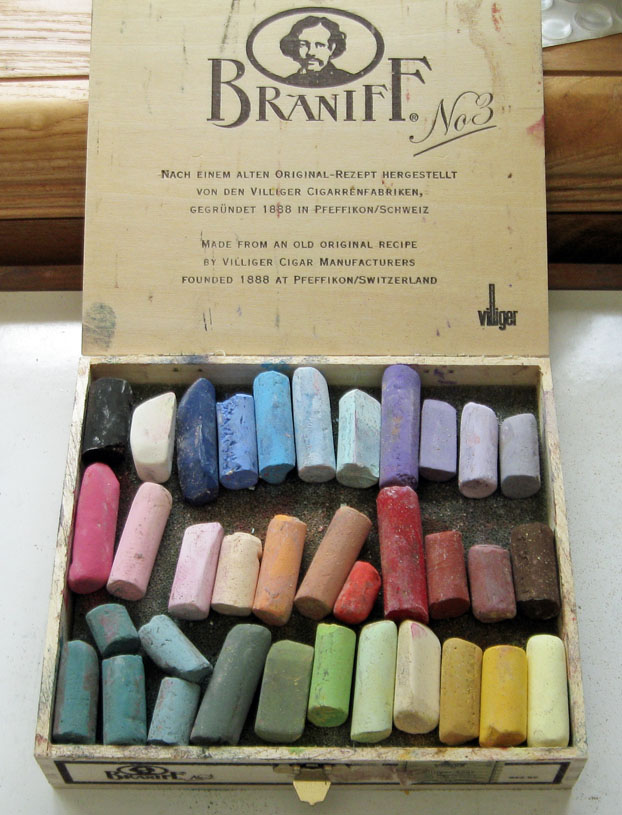
What inspires me the most is how wonderful his color choices were and his bold strokes.  Many pastelists blend the heck out of their work and it thrills me to see unblended work from the 1920’s.  It is also pretty easy to put together his very simple plein air palette from his work, which, of course, I had to do.  It seems to be very limited, which is great for going out on location.  Possibly, he had a small landscape set – I don’t know what was available in the ’20’s.  I managed to fit all the colors into a small 5″x4″ box – it doesn’t get better than that!

Since I don’t keep the names of my colors, and now realize I have way too many colors, yet, not enough of these colors, I’ve made a color chart of what his palette probably was.

John Pierce Barnes Palette
John Pierce Barnes Palette – it looks a little dark here but see below for actual pastel sticks
pastels for plein air
pastels for plein air – in a little cigar box

If it would stop raining I’d take them for a test ride.:)


Through the Oaks

Through the Oaks
Through the Oaks – 18×26 – pastels on sanded paper

This is from Adams Ranch in Ft. Pierce, FL where the live oaks grow undisturbed.  They are huge trees with far reaching limbs.  A bit farther down this dirt road on the ranch is a picnic area with a giant tree house.

I’m getting ready to start a new commission and while taking stock, making sure there were plenty of pastels in the box and planning my approach this painting came to mind.

The new painting won’t have a path with dappled light but many of the colors will be the same, as well as the size.

Better get to work!:)