The Sketchbook Project

The Sketchbook Project is fun to do and I’ve just signed up for the 2013 project.  In a nutshell – you sign up, pay for a blank sketchbook plus touring expenses and when you return it to the ArtHouse Coop it is cataloged and then goes on tour.

Here are some pages from my 2011 sketchbook – my theme was “Down my Road”, so these are all very local scenes.:
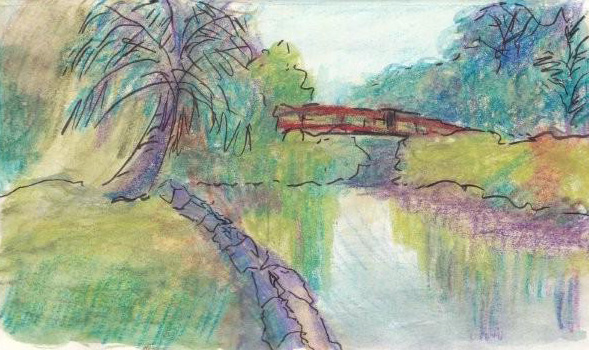
Japanese Bridge
Japanese Bridge – 2011 Sketchbook Project – watercolor crayons and market pens
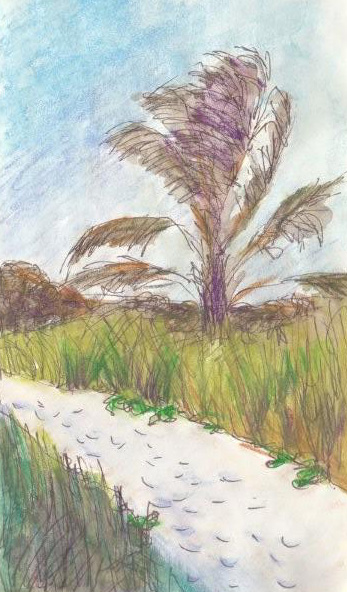
Five Dollar Beach
Five Dollar Beach – 2011 Sketchbook Project – watercolor crayon and marker pens
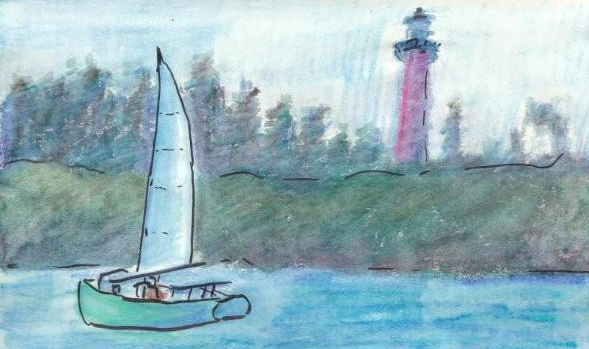
Sailing by Jupiter Lighthouse
Sailing by Jupiter Lighthouse – 2011 Sketchbook Project – watercolor crayon and marker pens
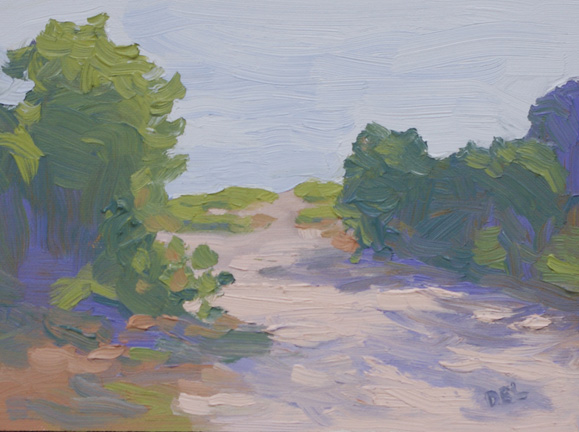
Hobe Sound Beach
Hobe Sound Beach – 2011 Sketchbook Project – watercolor crayon and marker pen
My Neighbor's Lemon Tree
My Neighbor’s Lemon Tree – 2011 Sketchbook Project – watercolor crayon and marker pen

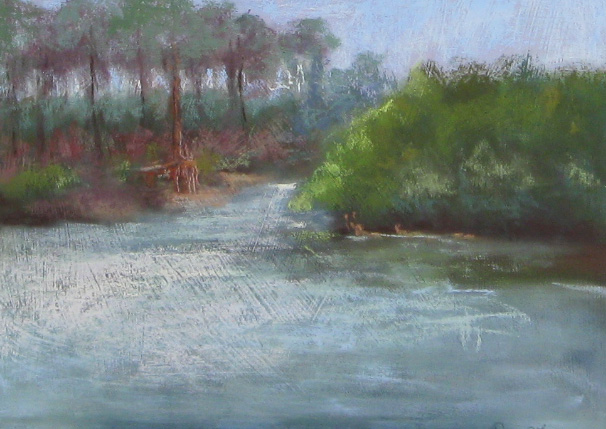
and last but not least because it is once again that great spot on the Loxahatchee River:

Loxahatchee River
Loxahatchee River – 2011 Sketchbook Project – watercolor crayon and marker pen

There were many more pages but this is enough to give you the gist of the sketchbook. The method that I used was fun.  The first sketch is with watercolor crayon, then apply water, let that dry, use the marker pens to outline or do some fancy scribbling and then a final layer of gray or white on top for atmosphere.

I’ve scanned in the 2012 sketchbook but haven’t downsized the files yet. Will post soon.

Now I’m looking forward to the 2013 project and hope I don’t procrastinate as much as I usually do finding myself filling the book two days before it’s due.
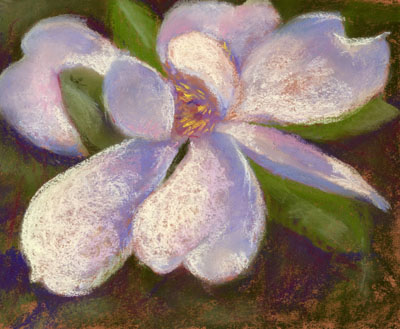
Magnolias!!!!!

Magnolia – 11×14 – pastel on paper

The magnolias are blooming like crazy this year – or more than they have in the past – I tend to exaggerate.  We have two trees in the yard.  One in the front and one in the back.

They are the big trees with the big flowers.  They smell great!  Some magnolia trees in the neighborhood are dwarf trees with the big flower, which is nice because the flowers are lower.  With the big tree it’s hard to even get a good photograph of the blooms because they are so high.  However, once in awhile, if you can catch it at the right moment (the flowers peak on one day and then they’re done!) blooming on a lower branch you’ll be able to at least have a photograph to work from.

Repeating Myself Again

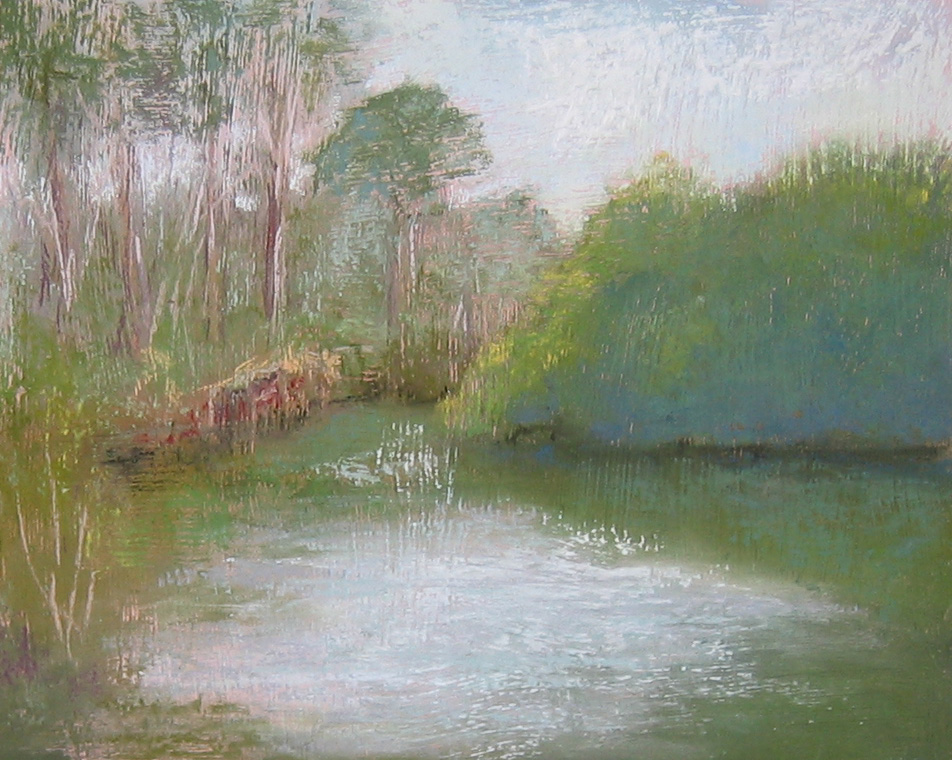
Here is one of my favorite painting spots at Jonathan Dickinson State Park on the bank of the Loxahatchee River.  In the past I’ve seen very large gators here and often there are kayakers going by too.  Not together.

This first plein air is done on an 8×10 panel that I made with a gritty coating to give the surface texture.  It’s done in pastels, pure brilliant pigment – in stick form – better than crayons!

Loxahatchee River
Loxahatchee River – 8×10 Pastel on Textured Panel – the gesso mixture used was also tinted light cadmium red and you can see the surface coming through

Next on the Loxahatchee, same place different day and time, was also a textured panel – much bigger and was done as a class demonstration.  The class wanted to also see how to underpaint so I used some rubbing alcohol over the pastels, which solidified the background.  Then I waited a bit for the painting to dry and finished the pastel on top.


Loxahatchee Again - 12x16 Pastel on Panel
Loxahatchee Again – 12×16 Pastel on Panel

Wait, I’m not done – there’s one more for now – this one is same place – of course a different day and time and different paper!  Viewpoint is slightly farther down on the river bank.  This one is my favorite – it too has an underpainting – this time with watercolor.

Banks of Loxahatchee - 9x12 - Pastel on sanded paper
Banks of Loxahatchee – 9×12 – Pastel on sanded paper

The watercolor underpainting is a great tool.  You can get some great darks in without getting too messy and build some beautiful shadow areas.  Also the pink undertone in the sky and water adds luminosity and air.

Looking at all these together like this makes me want to go there again.

I can’t promise that these are all the paintings that I have done or will do of the Loxahatchee River.

Why Paint?

Hobe Sound Rose Hobe Sound Rose – Pastel on paper – no camera involved (except to photograph the painting, that is) – a rose that I grew and a pot that I made.

The inspiration to paint can come from so many places……….. and yet there are some days you say to yourself, why paint?  Sometimes my inspiration is to just improve myself.  Most of the time I’m overwhelmed with ideas and objects that inspire me and then the thought runs through my head that I might be insane.  But that’s a whole nuther topic.

“Drawing as a means of expression is the justification of art over photography.” Andrew Loomis, Creative Illustration, 1947

How cool is that?  We’re still discussing this today in 2012, yet some people have never even been made aware of it.  It bothers me that there are so many people that judge good art by how close to a photograph the painting it is.  Not to mention the hyperrealist or photorealist painters that have the goal of painstakingly reproducing a photograph.  As if the photograph were the standard that paintings had to live up to.

Don’t misunderstand and think that I’m not in favor of photography because I love photography! It seems that over time artistic goals have sometimes become distorted.

Mr. Loomis was directing this to the art student (in the 1940’s!!!) and comparing  original illustration to photography which he said couldn’t provide the expressiveness that the artist could. He doesn’t throw photography out the window but at that time guides the artist to understand they aren’t being replaced by a camera.  Even though we now have the means to be more expressive with digital applications, the camera still can’t produce the surface and line quality nor the atmosphere and character that original art can.

So that is why you paint – to go beyond the photograph with your personal expression of the poetic landscape (or what ever your thing is).  One good reason,  anyway.

Sometimes it seems that things and/or thoughts are presented to you by some unseen spirit and you can’t help but think it must be meaningful.  Kismet.  Destiny.  Some amazing global consciousness!  Why else would all of these things come together at the same time?

Yes, I’m looking for answers and finding the ones that suit me but so are many other people which is validation enough for me.  Because after all, I do need to justify my obsession and insanity.

Riverbend

Riverbend
Riverbend - 8x10 Oil on Panel - Plein Air

Last week I painted this at Riverbend Park in Jupiter, FL.  It was the first time there for me and I was surprised at how big the park actually is.  There were many scenic views to choose from but since my pan head connection (the little foot that connects my palette to the tripod) was nowhere to be found, I had to make use of one of the picnic tables that had the added convenience of a chickee roof.  (The things that are made out of palm fronds.)

When I first arrived there was a man fishing on the river bank and he had all his gear on what I considered prime real estate – the picnic table with the view.  When I asked if we could share the table he was more than happy to accommodate, so problem solved.

However, not long after getting set up and ready to paint there were several more people that joined the painting group I was there with.  They saw me and thought that was the place to be, so we literally moved him completely out.  At first I felt bad, but he seemed to be enjoying the comradery and really, fishing/plein air painting, same thing.

The only down side was that two of the ladies set up in  front of me, sort of obstructing my view, but you win some and you lose some.  In the end, I won this little painting and I managed to get home before it rained!:)

The same path

So, after I posted and edited and updated “This Way to the Beach” I was thinking about it and it seemed like something that would be a fun monotype print.  Apparently, that thought ran across my mind before because here it is – done already:

This Way to the Beach Again

In fact, it’s posted on my original WordPress blog, that I haven’t been using because it didn’t link me to my location.

That blog is found at: http://useallthecrayons.wordpress.com/ and oddly enough, my last post was on monotypes, this one included.   Hope you don’t mind the resurrection.

Please let me know if there is  too much redundancy because obviously it doesn’t occur to me.  Sometimes I’ll draw or paint the same thing until it’s right or because it’s a pleasant composition.  Don’t you think it’s interesting to see how the same subject looks with different mediums?

This Way to the Beach

This Way to the Beach

This Way to the Beach – 6×8 oil on panel

Using very visible brush marks and staying away from detail – Done!

Yesterday I was very non-communicative, keeping everything inside as usual.  My apologies – especially to myself! Here’s what I meant to say:

This path to the beach is on Jupiter Island, FL and really does have the perfect “S” shaped path that is a must component for a perfect composition.

(Read Edgar Paynes book: “Composition of Outdoor Painting” for other great compositional tips.)

The “S” shape leads you into the painting and makes your eye wander around.  In this case it wasn’t something I made up – I found it there while driving down the road to the beach on the north end of the island.  It’s private property so I couldn’t just pull over and paint.  But, I usually just snap a picture so that I can paint it later when presented with a situation like that.  Actually I also will take many pictures for later reference even if I’m on location painting.

Painting from photographs is a challenge because the camera doesn’t duplicate what we see with our eyes.  However, there are two things that are good about photographs – one you can take your time with the painting because the light won’t be changing and second you can view the picture on your computer screen and it’s a fairly good replication of outdoor light.  The one thing I modified immediately was to not include the “for sale” sign in front of the bushes.  Next I decided that in order to compensate for the unruly shadows produced by the camera I would paint in a lighter range, something I’m working on in general.

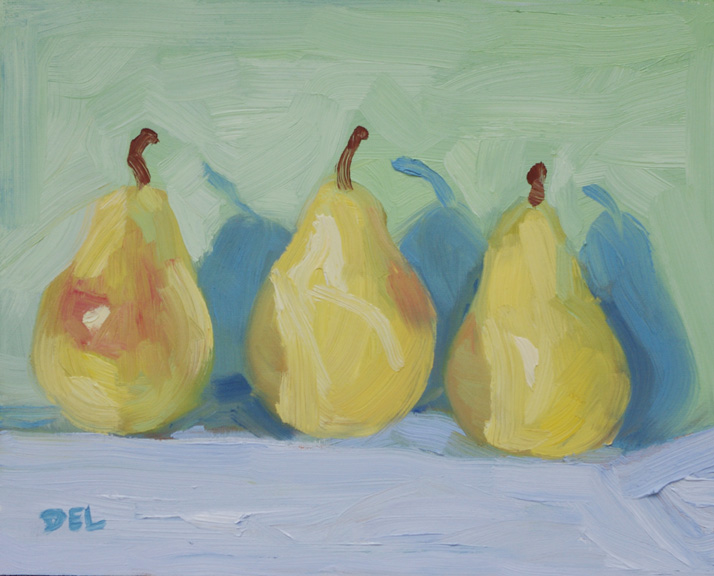
Chorus Line

Chorus Line
Chorus Line, 8x10 Oil on Panel

The practice of setting up a small still life and limiting the time you spend on it has been around for a long time and it’s a practice that I enjoy.  Some of the most inspiring subjects are in the produce department and I find myself there testing the bartlet pears quite often.  Most people might be looking for softness, ripeness, but my tests are: can the pear can stand on it’s own, is it a shapely pear, and of course, how good is the color?

Once they’re home with me, I set them up with dramatic lighting, as if they are on stage!  With this painting my goals were to improve my brush work and to keep the colors light and appealing.

Using a bristle flat brush is greatly improving my brush work since it holds more paint and the marks are showing how luscious the paint is.  The pears were juicy and luscious, so they should be depicted that way.  My palette is a simple rainbow palette that I’ve been using for years but I’ve lightened things up now, reminding myself to stay in the higher value range.

The Soloist - 5x7 oil on panel

This guy needed his portrait painted and didn’t have anything to do with that other group.

Thanks to the sale a Jay Mar, I’m stocked up on canvas now and will be painting more still lifes in the near future.

My collection of thrift store finds will be a future series of paintings and great composition practice.

Feel free to give me feedback or ask any questions in the comments section and thanks for looking!


Framing Tips for Artists

This is from my custom framing website and thought some might find something useful in this list of tips.

A well framed work of art reflects on the artist’s professionalism.

Use archival acid free framing materials to better preserve your piece of art.

Mats should be ragboard, 100% cotton rag.  The color selection is much wider than it used to be.

If you are framing to sell, consider using the most elegant selections possible that would fit in with any décor.  This not only increases the chance of a sale but really showcases your artwork. It’s great when the buyer’s first thought is not one of what to do about the frame but one of admiration of the total package.

If you are framing for a juried show then choose the most conservative route.  Neutral color mats with plain frames. Your work will fit in anywhere!

No matter what choices you make be sure to make a solid presentation with the best archival material you can afford.

Matting Guide:

How you mat your work can add to or detract from your piece of art.

An undersized border will make your work looked cramped.  Here are some good guidelines for mat border sizing:

    Up to 11×14 use a 2.5” border
    Up to 16×20 use a 3” border
    Up to 24×28 use a 4” border
    Larger than 32×40 use a 6” or larger border

The next thing to address is deciding on the border weighting.  A really great look for small work is to use an oversize border, which makes the work stand out more and look important.

In general,  if the artwork itself has an evenly weighted composition then the borders too should be evenly weighted.

Increasing the bottom border by no more than 1” will lift the art visually

If the work is vertical and tall, adding weight at the bottom is effective.

Wide side borders look well with a long, narrow, horizontal image.


REMEMBER – IF YOU WANT TO LEAVE YOUR MARK ON THE WORLD – MAKE IT A GREAT MARK!!!